
- Home
- SEODiscover the latest updates from across the United States, including politics, culture, economy, and trending stories. Stay informed on the key events shaping the nation and the topics everyone’s talking about.
- Technical SEOLearn technical SEO concepts including crawling, indexing, XML sitemaps, robots.txt, canonical tags, site architecture, and website performance.
- Local SEOOptimize your business for local seo with Google Business Profile, local citations, reviews, maps, and location-based SEO.
- Mobile SEOImprove your website’s mobile seo performance with responsive design, mobile-first indexing, usability, and page speed optimization.
- On-Page SEOExplore on-page seo optimization techniques such as title tags, meta descriptions, headings, URLs, internal linking, and content optimization.
- Off-Page SEODiscover off-page SEO strategies such as backlinks, digital PR, brand mentions, outreach, and authority building.
- SEO ToolsExplore the best SEO tools for keyword research, technical audits, backlink analysis, rank tracking, and website optimization.
- Core Web VitalsLearn how to improve Core Web Vitals including LCP, INP, CLS, page speed, and overall user experience for better rankings.
- Keyword ResearchLearn how to find profitable keywords, analyze search intent, evaluate competition, and build effective keyword strategies.
- Link BuildingMaster ethical link building techniques, backlink analysis, outreach methods, guest posting, and authority growth strategies.
- Google Search ConsoleLearn how to use Google Search Console to monitor indexing, fix errors, analyze search performance, and improve SEO.
- SEO BasicsLearn the fundamentals of search engine optimization (SEO Basics), including how search engines work, SEO terminology, and beginner-friendly best practices.
- Paid Media
- Display AdvertisingLearn display advertising strategies, banner ads, audience targeting, remarketing, Google Display campaigns, and optimization techniques.
- Google AdsLearn Google Ads strategies, campaign setup, bidding, keywords, Performance Max, Search Ads, and optimization techniques.
- LinkedIn AdsLearn LinkedIn Ads strategies for B2B marketing, lead generation, audience targeting, campaign optimization, and paid social advertising.
- Meta AdsLearn Meta Ads strategies for Facebook and Instagram, including campaign setup, targeting, retargeting, and performance optimization.
- Paid Media AnalyticsLearn paid media analytics, including CPC, CTR, CPA, ROAS, conversion tracking, attribution, reporting, and campaign performance analysis.
- PPC StrategyLearn effective PPC strategies, campaign planning, bidding, keyword targeting, landing pages, conversion optimization, and more.
- ContentTransform your living spaces with inspiration, tips, and trends in interior design. From minimalist decor to bold statements, find ideas for every style and budget.
- Social
- Digital MarketingExplore stories and advice on living your best life. From personal growth to entertainment, dive into the latest in lifestyle trends and inspiration.
- Artificial IntelligenceStay informed about health and wellness with expert advice, fitness tips, and the latest medical breakthroughs. Your guide to a healthier and happier life.
- DevelopmentYou will find development related educational articles
- GTMLearn Google Tag Manager (GTM) with practical guides for tags, triggers, variables, tracking, conversions, and website analytics implementation.
- HTMLLearn HTML with simple tutorials, examples, tags, elements, attributes, and best practices for building modern web pages.
- HTML CSSLearn HTML CSS together with practical tutorials, examples, layouts, styling techniques, responsive design, and modern web development practices.
- HTML JSLearn HTML JS – JavaScript with practical tutorials and examples for adding interactivity, dynamic content, events, and functionality to web pages.
- JavaScriptExplore JavaScript tutorials, examples, concepts, and practical techniques for creating interactive and dynamic websites and web applications.
- PHPLearn PHP programming with practical tutorials, examples, functions, syntax, and web development techniques for beginners and developers.
- PythonLearn Python programming with practical tutorials, examples, syntax, functions, automation techniques, and useful programming concepts.
- Home
- SEODiscover the latest updates from across the United States, including politics, culture, economy, and trending stories. Stay informed on the key events shaping the nation and the topics everyone’s talking about.
- Technical SEOLearn technical SEO concepts including crawling, indexing, XML sitemaps, robots.txt, canonical tags, site architecture, and website performance.
- Local SEOOptimize your business for local seo with Google Business Profile, local citations, reviews, maps, and location-based SEO.
- Mobile SEOImprove your website’s mobile seo performance with responsive design, mobile-first indexing, usability, and page speed optimization.
- On-Page SEOExplore on-page seo optimization techniques such as title tags, meta descriptions, headings, URLs, internal linking, and content optimization.
- Off-Page SEODiscover off-page SEO strategies such as backlinks, digital PR, brand mentions, outreach, and authority building.
- SEO ToolsExplore the best SEO tools for keyword research, technical audits, backlink analysis, rank tracking, and website optimization.
- Core Web VitalsLearn how to improve Core Web Vitals including LCP, INP, CLS, page speed, and overall user experience for better rankings.
- Keyword ResearchLearn how to find profitable keywords, analyze search intent, evaluate competition, and build effective keyword strategies.
- Link BuildingMaster ethical link building techniques, backlink analysis, outreach methods, guest posting, and authority growth strategies.
- Google Search ConsoleLearn how to use Google Search Console to monitor indexing, fix errors, analyze search performance, and improve SEO.
- SEO BasicsLearn the fundamentals of search engine optimization (SEO Basics), including how search engines work, SEO terminology, and beginner-friendly best practices.
- Paid Media
- Display AdvertisingLearn display advertising strategies, banner ads, audience targeting, remarketing, Google Display campaigns, and optimization techniques.
- Google AdsLearn Google Ads strategies, campaign setup, bidding, keywords, Performance Max, Search Ads, and optimization techniques.
- LinkedIn AdsLearn LinkedIn Ads strategies for B2B marketing, lead generation, audience targeting, campaign optimization, and paid social advertising.
- Meta AdsLearn Meta Ads strategies for Facebook and Instagram, including campaign setup, targeting, retargeting, and performance optimization.
- Paid Media AnalyticsLearn paid media analytics, including CPC, CTR, CPA, ROAS, conversion tracking, attribution, reporting, and campaign performance analysis.
- PPC StrategyLearn effective PPC strategies, campaign planning, bidding, keyword targeting, landing pages, conversion optimization, and more.
- ContentTransform your living spaces with inspiration, tips, and trends in interior design. From minimalist decor to bold statements, find ideas for every style and budget.
- Social
- Digital MarketingExplore stories and advice on living your best life. From personal growth to entertainment, dive into the latest in lifestyle trends and inspiration.
- Artificial IntelligenceStay informed about health and wellness with expert advice, fitness tips, and the latest medical breakthroughs. Your guide to a healthier and happier life.
- DevelopmentYou will find development related educational articles
- GTMLearn Google Tag Manager (GTM) with practical guides for tags, triggers, variables, tracking, conversions, and website analytics implementation.
- HTMLLearn HTML with simple tutorials, examples, tags, elements, attributes, and best practices for building modern web pages.
- HTML CSSLearn HTML CSS together with practical tutorials, examples, layouts, styling techniques, responsive design, and modern web development practices.
- HTML JSLearn HTML JS – JavaScript with practical tutorials and examples for adding interactivity, dynamic content, events, and functionality to web pages.
- JavaScriptExplore JavaScript tutorials, examples, concepts, and practical techniques for creating interactive and dynamic websites and web applications.
- PHPLearn PHP programming with practical tutorials, examples, functions, syntax, and web development techniques for beginners and developers.
- PythonLearn Python programming with practical tutorials, examples, syntax, functions, automation techniques, and useful programming concepts.
Now Reading: How Google AI Mode Decides Which Websites to Cite
-
01
How Google AI Mode Decides Which Websites to Cite
- Home//
- SEO//Discover the latest updates from across the United States, including politics, culture, economy, and trending stories. Stay informed on the key events shaping the nation and the topics everyone’s talking about.
- Technical SEO//Learn technical SEO concepts including crawling, indexing, XML sitemaps, robots.txt, canonical tags, site architecture, and website performance.
- Local SEO//Optimize your business for local seo with Google Business Profile, local citations, reviews, maps, and location-based SEO.
- Mobile SEO//Improve your website’s mobile seo performance with responsive design, mobile-first indexing, usability, and page speed optimization.
- On-Page SEO//Explore on-page seo optimization techniques such as title tags, meta descriptions, headings, URLs, internal linking, and content optimization.
- Off-Page SEO//Discover off-page SEO strategies such as backlinks, digital PR, brand mentions, outreach, and authority building.
- SEO Tools//Explore the best SEO tools for keyword research, technical audits, backlink analysis, rank tracking, and website optimization.
- Core Web Vitals//Learn how to improve Core Web Vitals including LCP, INP, CLS, page speed, and overall user experience for better rankings.
- Keyword Research//Learn how to find profitable keywords, analyze search intent, evaluate competition, and build effective keyword strategies.
- Link Building//Master ethical link building techniques, backlink analysis, outreach methods, guest posting, and authority growth strategies.
- Google Search Console//Learn how to use Google Search Console to monitor indexing, fix errors, analyze search performance, and improve SEO.
- SEO Basics//Learn the fundamentals of search engine optimization (SEO Basics), including how search engines work, SEO terminology, and beginner-friendly best practices.
- Paid Media//
- Display Advertising//Learn display advertising strategies, banner ads, audience targeting, remarketing, Google Display campaigns, and optimization techniques.
- Google Ads//Learn Google Ads strategies, campaign setup, bidding, keywords, Performance Max, Search Ads, and optimization techniques.
- LinkedIn Ads//Learn LinkedIn Ads strategies for B2B marketing, lead generation, audience targeting, campaign optimization, and paid social advertising.
- Meta Ads//Learn Meta Ads strategies for Facebook and Instagram, including campaign setup, targeting, retargeting, and performance optimization.
- Paid Media Analytics//Learn paid media analytics, including CPC, CTR, CPA, ROAS, conversion tracking, attribution, reporting, and campaign performance analysis.
- PPC Strategy//Learn effective PPC strategies, campaign planning, bidding, keyword targeting, landing pages, conversion optimization, and more.
- Content//Transform your living spaces with inspiration, tips, and trends in interior design. From minimalist decor to bold statements, find ideas for every style and budget.
- Social//
- Digital Marketing//Explore stories and advice on living your best life. From personal growth to entertainment, dive into the latest in lifestyle trends and inspiration.
- Artificial Intelligence//Stay informed about health and wellness with expert advice, fitness tips, and the latest medical breakthroughs. Your guide to a healthier and happier life.
- Development//You will find development related educational articles
- GTM//Learn Google Tag Manager (GTM) with practical guides for tags, triggers, variables, tracking, conversions, and website analytics implementation.
- HTML//Learn HTML with simple tutorials, examples, tags, elements, attributes, and best practices for building modern web pages.
- HTML CSS//Learn HTML CSS together with practical tutorials, examples, layouts, styling techniques, responsive design, and modern web development practices.
- HTML JS//Learn HTML JS – JavaScript with practical tutorials and examples for adding interactivity, dynamic content, events, and functionality to web pages.
- JavaScript//Explore JavaScript tutorials, examples, concepts, and practical techniques for creating interactive and dynamic websites and web applications.
- PHP//Learn PHP programming with practical tutorials, examples, functions, syntax, and web development techniques for beginners and developers.
- Python//Learn Python programming with practical tutorials, examples, syntax, functions, automation techniques, and useful programming concepts.
- Home
- Artificial Intelligence
- How Google AI Mode Decides Which Websites to Cite
How Google AI Mode Decides Which Websites to Cite

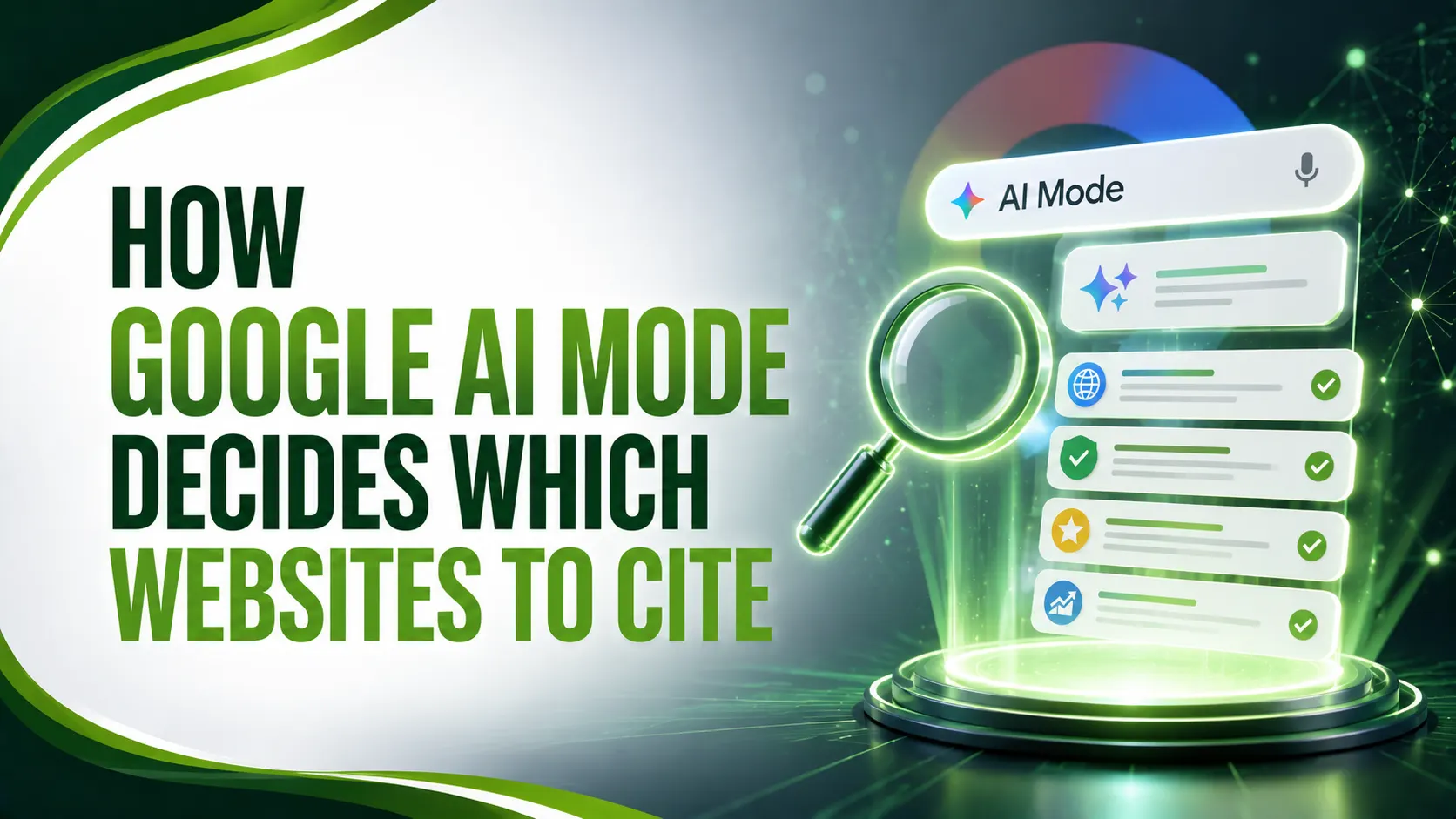
Google AI Mode decides citations through query fan-out — and increasingly cites Google's own properties. Here's what the 2026 data actually shows.
Table of Contents
ToggleGoogle AI Mode decides which websites to cite through a mechanism called query fan-out, breaking one question into several behind-the-scenes searches, retrieving results across all of them, then synthesizing an answer with inline citations. It shares Google's index, but the selection criteria genuinely diverge from regular organic rankings.
The gap is bigger than most site owners assume. A Moz analysis of nearly 40,000 queries found 88% of Google AI Mode citations come from outside the organic top 10 entirely.
There's also a pattern few expect: Google increasingly cites itself. Here's exactly how the selection mechanism works, and what the current data shows actually gets chosen.
01Google AI Mode's Core Mechanism: Query Fan-Out
VerseOdin's guide explains the mechanism plainly: query fan-out is what decides what gets pulled into an AI Mode answer in the first place. When a query comes in, Google's systems assess its complexity and intent, then decide how aggressively to fan it out into sub-queries.
Arobis AI's guide adds the practical range: a simple factual question might generate few or no additional sub-queries, while a complex comparison or planning question can be broken into a dozen or more, each retrieving content from Google's index independently before everything gets synthesized into one answer.
02The Growing Pattern of Google Citing Itself
ALM Corp's March 2026 study of 1.3 million Google AI Mode citations found something worth knowing before you plan strategy: Google.com is the most-cited domain at 17.42%, more than YouTube, Reddit, and Amazon combined.
Shadow's July 2026 analysis, citing Profound's research, confirms this accelerated sharply: Google.com's citation share within AI Mode surged 8.4x between April and June 2026, driven almost entirely by Google Business Profiles and Product Knowledge Panels rather than regular search result pages.
ALM Corp's research, referenced above, found the self-citation pattern used to be almost entirely local. As recently as June 2025, 97.9% of Google's self-citations pointed to Google Business Profiles for restaurants, mechanics, and dental clinics. By February 2026, AI Mode had expanded this to route informational, navigational, and transactional queries through Google properties too, not just local ones.
03Why Ranking Well No Longer Guarantees a Citation
FirstMotion's guide documents the decoupling with real numbers: in July 2025, 76% of AI Overview citations came from pages ranking in the organic top 10. By March 2026, that figure had fallen to just 38%, a 50% relative decline in eight months.
Shadow's guide, referenced above, confirms the same figure for AI Mode specifically: only 38% of cited URLs rank in the top 10 for the query they're cited on. This mirrors exactly what our AI search ranking factors guide found across engines broadly, ranking and citation have become genuinely separate outcomes.
04What Actually Predicts an AI Mode Citation
SE Ranking's March 2026 study, analyzing the top 20 most impactful factors, found domain-level authority and brand visibility dominate the list. Overall domain traffic from regular Google organic search turned out to be the single biggest factor influencing AI Mode citations.
The same study found high-traffic domains are almost three times more likely to be cited than low-traffic ones. Sites with very low traffic average about 3.6 citations, while high-traffic leaders average around 6.5, with referring domain count and content length following close behind traffic as predictive factors.
05AI Mode vs AI Overviews: Different Selection Criteria
FirstMotion's guide, referenced above, draws a distinction worth understanding: AI Overviews focus on informational queries and cite passages rather than entire pages, correlating more strongly with organic rankings than AI Mode does, though that correlation has weakened significantly through 2026.
Discovered Labs' technical analysis adds a structural detail: AI Overviews load through a dedicated async endpoint entirely separate from regular search results, using its own ML routing and a server-side retrieval phase that completes in roughly 200 milliseconds before generation even begins.
06Preferred Sources: A New Citation Lever
SEO-Kreativ's guide covers a genuinely new mechanism added in 2026: Google now lets searchers mark specific publishers as Preferred Sources, which then get surfaced more often inside both AI Overviews and AI Mode, with reported click-through likelihood roughly doubling for preferred sources over non-preferred ones.
SEO-Kreativ's guide, referenced above, flags a specific limit that's been in Google's documentation since August 20, 2026: only full domains and subdomains are eligible for the Preferred Sources feature. A subdirectory like example.com/blog explicitly does not qualify, so this lever depends on how your site is structured, not just how good your content is.
07Citation Factors Ranked by Impact
A quick reference based on SE Ranking's factor analysis and the broader 2026 research covered above.
| Factor | Impact Level | What It Reflects |
|---|---|---|
| Organic domain traffic | Highest | Overall brand reach and real-world usage |
| Referring domain count | High | Third-party trust and earned authority |
| Content length / depth | Moderate-High | Topical comprehensiveness |
| Top-10 organic ranking | Moderate, declining | Traditional relevance, weaker correlation each year |
| Preferred Source status | Emerging | Reader-driven trust signal, domain-level only |
08Practical Steps for AI Mode Visibility
A short list based on the factors covered above.
Grow overall organic traffic, it's the single strongest predictor identified in SE Ranking's factor study.
Build genuine referring domains, earned links remain a strong trust signal independent of rankings.
Don't rely on top-10 rankings alone, given the 50% relative decline in that correlation since mid-2025.
Structure content at the domain/subdomain level where possible, to stay eligible for Preferred Sources.
Expect Google properties to occupy some citation slots, and plan third-party citation strategy around that reality.
09How Likely Are You to Get Cited in AI Mode?
Answer a few quick questions to check your current positioning.
How Likely Are You to Get Cited?
Select the option that matches your site
10Common Questions
No. Only about 38% of AI Mode citations come from pages ranking in the organic top 10, down sharply from 76% in mid-2025.
It's the mechanism that breaks one user question into multiple sub-queries, retrieves results for each independently, then synthesizes them into a single answer with inline citations.
Google.com's citation share has grown 8.4x recently, driven mainly by Google Business Profiles and Product Knowledge Panels rather than general search results, effectively keeping users inside Google's own ecosystem.
Overall organic domain traffic, according to SE Ranking's 2026 factor analysis. High-traffic domains are nearly three times more likely to be cited than low-traffic ones.
A 2026 feature letting searchers mark specific publishers as preferred, which then get surfaced more often. Only full domains and subdomains are eligible, subdirectories don't qualify.
Related Articles
What We Learn Today
Query fan-out breaks questions into multiple sub-searches
Google.com has become a major self-cited domain in AI Mode
Only 38% of AI Mode citations rank in the organic top 10
Organic traffic is the single strongest citation predictor
AI Mode and AI Overviews use meaningfully different criteria
Preferred Sources only apply at the domain/subdomain level
Build a Complete Google AI Visibility Strategy
Understanding AI Mode's citation mechanism pairs well with the cross-engine ranking factors covered separately. Explore both guides next.
Related Posts

Previous Post
Next Post


- Artificial Intelligence
- Content
- Core Web Vitals
- Development
- Digital Marketing
- Display Advertising
- Google Ads
- Google Search Console
- GTM
- HTML
- HTML CSS
- JavaScript
- Keyword Research
- Link Building
- LinkedIn Ads
- Local SEO
- Meta Ads
- Mobile SEO
- Off-Page SEO
- On-Page SEO
- Paid Media
- Paid Media Analytics
- PHP
- PPC Strategy
- Python
- SEO
- SEO Basics
- SEO Tools
- Social
- Technical SEO