
- Home
- SEODiscover the latest updates from across the United States, including politics, culture, economy, and trending stories. Stay informed on the key events shaping the nation and the topics everyone’s talking about.
- Technical SEOLearn technical SEO concepts including crawling, indexing, XML sitemaps, robots.txt, canonical tags, site architecture, and website performance.
- Local SEOOptimize your business for local seo with Google Business Profile, local citations, reviews, maps, and location-based SEO.
- Mobile SEOImprove your website’s mobile seo performance with responsive design, mobile-first indexing, usability, and page speed optimization.
- On-Page SEOExplore on-page seo optimization techniques such as title tags, meta descriptions, headings, URLs, internal linking, and content optimization.
- Off-Page SEODiscover off-page SEO strategies such as backlinks, digital PR, brand mentions, outreach, and authority building.
- SEO ToolsExplore the best SEO tools for keyword research, technical audits, backlink analysis, rank tracking, and website optimization.
- Core Web VitalsLearn how to improve Core Web Vitals including LCP, INP, CLS, page speed, and overall user experience for better rankings.
- Keyword ResearchLearn how to find profitable keywords, analyze search intent, evaluate competition, and build effective keyword strategies.
- Link BuildingMaster ethical link building techniques, backlink analysis, outreach methods, guest posting, and authority growth strategies.
- Google Search ConsoleLearn how to use Google Search Console to monitor indexing, fix errors, analyze search performance, and improve SEO.
- SEO BasicsLearn the fundamentals of search engine optimization (SEO Basics), including how search engines work, SEO terminology, and beginner-friendly best practices.
- Paid Media
- Display AdvertisingLearn display advertising strategies, banner ads, audience targeting, remarketing, Google Display campaigns, and optimization techniques.
- Google AdsLearn Google Ads strategies, campaign setup, bidding, keywords, Performance Max, Search Ads, and optimization techniques.
- LinkedIn AdsLearn LinkedIn Ads strategies for B2B marketing, lead generation, audience targeting, campaign optimization, and paid social advertising.
- Meta AdsLearn Meta Ads strategies for Facebook and Instagram, including campaign setup, targeting, retargeting, and performance optimization.
- Paid Media AnalyticsLearn paid media analytics, including CPC, CTR, CPA, ROAS, conversion tracking, attribution, reporting, and campaign performance analysis.
- PPC StrategyLearn effective PPC strategies, campaign planning, bidding, keyword targeting, landing pages, conversion optimization, and more.
- ContentTransform your living spaces with inspiration, tips, and trends in interior design. From minimalist decor to bold statements, find ideas for every style and budget.
- Social
- Digital MarketingExplore stories and advice on living your best life. From personal growth to entertainment, dive into the latest in lifestyle trends and inspiration.
- Artificial IntelligenceStay informed about health and wellness with expert advice, fitness tips, and the latest medical breakthroughs. Your guide to a healthier and happier life.
- DevelopmentYou will find development related educational articles
- GTMLearn Google Tag Manager (GTM) with practical guides for tags, triggers, variables, tracking, conversions, and website analytics implementation.
- HTMLLearn HTML with simple tutorials, examples, tags, elements, attributes, and best practices for building modern web pages.
- HTML CSSLearn HTML CSS together with practical tutorials, examples, layouts, styling techniques, responsive design, and modern web development practices.
- HTML JSLearn HTML JS – JavaScript with practical tutorials and examples for adding interactivity, dynamic content, events, and functionality to web pages.
- JavaScriptExplore JavaScript tutorials, examples, concepts, and practical techniques for creating interactive and dynamic websites and web applications.
- PHPLearn PHP programming with practical tutorials, examples, functions, syntax, and web development techniques for beginners and developers.
- PythonLearn Python programming with practical tutorials, examples, syntax, functions, automation techniques, and useful programming concepts.
- Home
- SEODiscover the latest updates from across the United States, including politics, culture, economy, and trending stories. Stay informed on the key events shaping the nation and the topics everyone’s talking about.
- Technical SEOLearn technical SEO concepts including crawling, indexing, XML sitemaps, robots.txt, canonical tags, site architecture, and website performance.
- Local SEOOptimize your business for local seo with Google Business Profile, local citations, reviews, maps, and location-based SEO.
- Mobile SEOImprove your website’s mobile seo performance with responsive design, mobile-first indexing, usability, and page speed optimization.
- On-Page SEOExplore on-page seo optimization techniques such as title tags, meta descriptions, headings, URLs, internal linking, and content optimization.
- Off-Page SEODiscover off-page SEO strategies such as backlinks, digital PR, brand mentions, outreach, and authority building.
- SEO ToolsExplore the best SEO tools for keyword research, technical audits, backlink analysis, rank tracking, and website optimization.
- Core Web VitalsLearn how to improve Core Web Vitals including LCP, INP, CLS, page speed, and overall user experience for better rankings.
- Keyword ResearchLearn how to find profitable keywords, analyze search intent, evaluate competition, and build effective keyword strategies.
- Link BuildingMaster ethical link building techniques, backlink analysis, outreach methods, guest posting, and authority growth strategies.
- Google Search ConsoleLearn how to use Google Search Console to monitor indexing, fix errors, analyze search performance, and improve SEO.
- SEO BasicsLearn the fundamentals of search engine optimization (SEO Basics), including how search engines work, SEO terminology, and beginner-friendly best practices.
- Paid Media
- Display AdvertisingLearn display advertising strategies, banner ads, audience targeting, remarketing, Google Display campaigns, and optimization techniques.
- Google AdsLearn Google Ads strategies, campaign setup, bidding, keywords, Performance Max, Search Ads, and optimization techniques.
- LinkedIn AdsLearn LinkedIn Ads strategies for B2B marketing, lead generation, audience targeting, campaign optimization, and paid social advertising.
- Meta AdsLearn Meta Ads strategies for Facebook and Instagram, including campaign setup, targeting, retargeting, and performance optimization.
- Paid Media AnalyticsLearn paid media analytics, including CPC, CTR, CPA, ROAS, conversion tracking, attribution, reporting, and campaign performance analysis.
- PPC StrategyLearn effective PPC strategies, campaign planning, bidding, keyword targeting, landing pages, conversion optimization, and more.
- ContentTransform your living spaces with inspiration, tips, and trends in interior design. From minimalist decor to bold statements, find ideas for every style and budget.
- Social
- Digital MarketingExplore stories and advice on living your best life. From personal growth to entertainment, dive into the latest in lifestyle trends and inspiration.
- Artificial IntelligenceStay informed about health and wellness with expert advice, fitness tips, and the latest medical breakthroughs. Your guide to a healthier and happier life.
- DevelopmentYou will find development related educational articles
- GTMLearn Google Tag Manager (GTM) with practical guides for tags, triggers, variables, tracking, conversions, and website analytics implementation.
- HTMLLearn HTML with simple tutorials, examples, tags, elements, attributes, and best practices for building modern web pages.
- HTML CSSLearn HTML CSS together with practical tutorials, examples, layouts, styling techniques, responsive design, and modern web development practices.
- HTML JSLearn HTML JS – JavaScript with practical tutorials and examples for adding interactivity, dynamic content, events, and functionality to web pages.
- JavaScriptExplore JavaScript tutorials, examples, concepts, and practical techniques for creating interactive and dynamic websites and web applications.
- PHPLearn PHP programming with practical tutorials, examples, functions, syntax, and web development techniques for beginners and developers.
- PythonLearn Python programming with practical tutorials, examples, syntax, functions, automation techniques, and useful programming concepts.
Now Reading: Value Based Bidding in Google Ads Explained
-
01
Value Based Bidding in Google Ads Explained
- Home//
- SEO//Discover the latest updates from across the United States, including politics, culture, economy, and trending stories. Stay informed on the key events shaping the nation and the topics everyone’s talking about.
- Technical SEO//Learn technical SEO concepts including crawling, indexing, XML sitemaps, robots.txt, canonical tags, site architecture, and website performance.
- Local SEO//Optimize your business for local seo with Google Business Profile, local citations, reviews, maps, and location-based SEO.
- Mobile SEO//Improve your website’s mobile seo performance with responsive design, mobile-first indexing, usability, and page speed optimization.
- On-Page SEO//Explore on-page seo optimization techniques such as title tags, meta descriptions, headings, URLs, internal linking, and content optimization.
- Off-Page SEO//Discover off-page SEO strategies such as backlinks, digital PR, brand mentions, outreach, and authority building.
- SEO Tools//Explore the best SEO tools for keyword research, technical audits, backlink analysis, rank tracking, and website optimization.
- Core Web Vitals//Learn how to improve Core Web Vitals including LCP, INP, CLS, page speed, and overall user experience for better rankings.
- Keyword Research//Learn how to find profitable keywords, analyze search intent, evaluate competition, and build effective keyword strategies.
- Link Building//Master ethical link building techniques, backlink analysis, outreach methods, guest posting, and authority growth strategies.
- Google Search Console//Learn how to use Google Search Console to monitor indexing, fix errors, analyze search performance, and improve SEO.
- SEO Basics//Learn the fundamentals of search engine optimization (SEO Basics), including how search engines work, SEO terminology, and beginner-friendly best practices.
- Paid Media//
- Display Advertising//Learn display advertising strategies, banner ads, audience targeting, remarketing, Google Display campaigns, and optimization techniques.
- Google Ads//Learn Google Ads strategies, campaign setup, bidding, keywords, Performance Max, Search Ads, and optimization techniques.
- LinkedIn Ads//Learn LinkedIn Ads strategies for B2B marketing, lead generation, audience targeting, campaign optimization, and paid social advertising.
- Meta Ads//Learn Meta Ads strategies for Facebook and Instagram, including campaign setup, targeting, retargeting, and performance optimization.
- Paid Media Analytics//Learn paid media analytics, including CPC, CTR, CPA, ROAS, conversion tracking, attribution, reporting, and campaign performance analysis.
- PPC Strategy//Learn effective PPC strategies, campaign planning, bidding, keyword targeting, landing pages, conversion optimization, and more.
- Content//Transform your living spaces with inspiration, tips, and trends in interior design. From minimalist decor to bold statements, find ideas for every style and budget.
- Social//
- Digital Marketing//Explore stories and advice on living your best life. From personal growth to entertainment, dive into the latest in lifestyle trends and inspiration.
- Artificial Intelligence//Stay informed about health and wellness with expert advice, fitness tips, and the latest medical breakthroughs. Your guide to a healthier and happier life.
- Development//You will find development related educational articles
- GTM//Learn Google Tag Manager (GTM) with practical guides for tags, triggers, variables, tracking, conversions, and website analytics implementation.
- HTML//Learn HTML with simple tutorials, examples, tags, elements, attributes, and best practices for building modern web pages.
- HTML CSS//Learn HTML CSS together with practical tutorials, examples, layouts, styling techniques, responsive design, and modern web development practices.
- HTML JS//Learn HTML JS – JavaScript with practical tutorials and examples for adding interactivity, dynamic content, events, and functionality to web pages.
- JavaScript//Explore JavaScript tutorials, examples, concepts, and practical techniques for creating interactive and dynamic websites and web applications.
- PHP//Learn PHP programming with practical tutorials, examples, functions, syntax, and web development techniques for beginners and developers.
- Python//Learn Python programming with practical tutorials, examples, syntax, functions, automation techniques, and useful programming concepts.
- Home
- Paid Media
- Google Ads
- Value Based Bidding in Google Ads Explained
Value Based Bidding in Google Ads Explained

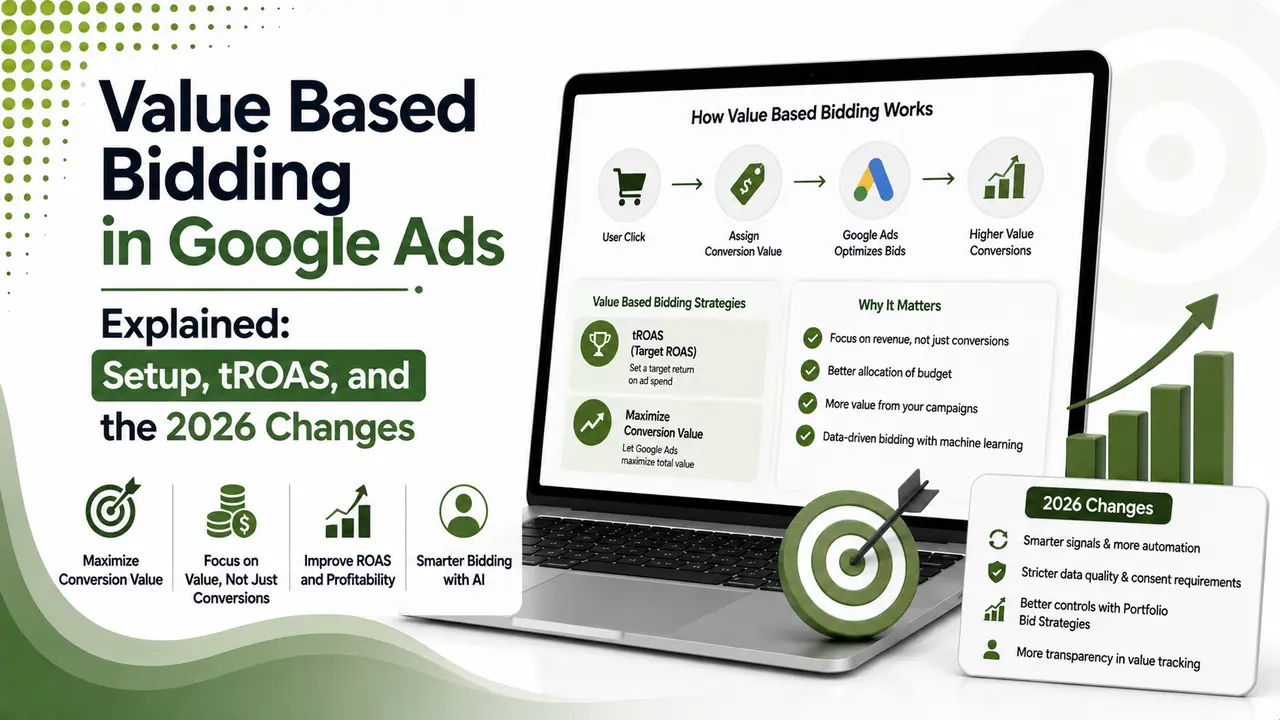
Value based bidding tells Google what each conversion is worth, not just how many you want. Here's how to set it up and what changed in 2026.
Table of Contents
ToggleValue based bidding in Google Ads means telling the algorithm what each conversion is actually worth to your business, not just how many conversions you want. Instead of "get me conversions at $80 each," you're saying "find me the conversions worth the most, and here's exactly what each type is worth."
The distinction matters more than it sounds. Target CPA treats a $15 newsletter signup and a $5,000 closed deal as equally worth chasing, as long as both cost roughly the same to acquire. Value based bidding tells Google to chase the deal.
2026 also brought real structural changes to how this works. Target CPA and Target ROAS got their standalone names back in June, and a bigger behavioral change lands August 17: budget-limited campaigns stop quietly overperforming their stated targets.
01What Value Based Bidding Actually Does
Google's own documentation defines it as a subset of Smart Bidding that optimizes campaigns based on the value a conversion brings to your business, either maximizing conversion value within budget or hitting a specific Target ROAS. That's different from conversion-based bidding, which chases volume regardless of what each conversion is actually worth.
CustomerLabs' guide illustrates the gap plainly: with tCPA, Google will happily bid the same $10 for a $100 signup and a $500 purchase, since both cost the same to acquire. Value based bidding is what teaches the algorithm to tell those two conversions apart.
02The June 2026 Naming Change
Google's own Help Center confirms the update directly: starting June 2026, "Maximize conversions with a Target CPA" reverted to simply "Target CPA," and "Maximize conversion value with a Target ROAS" became "Target ROAS." Google states plainly that the underlying bidding behavior is unchanged, this is a labeling fix, not a mechanism change.
Kick Ads' coverage adds useful context for why this matters visually rather than functionally: a campaign labeled "Target CPA" now signals at a glance that it's running to a target, without needing to open bid settings to confirm it.
JumpFly's coverage flags the real behavioral shift: starting August 17, 2026, budget-limited campaigns using tCPA or tROAS get pulled closer to their literal stated target instead of quietly overperforming it. A campaign set to a $25 tCPA that's been delivering $14 conversions will get steered toward $25, not left alone at $14. Google will not adjust your targets automatically, that's a manual review you need to make yourself.
03What You Need Before Switching to Value Based Bidding
Google's requirements are specific. For Demand Gen campaigns, you need at least 50 conversions with value in the past 35 days, including a minimum of 10 in the past 7 days, or 100 conversions with value across all Demand Gen campaigns in 35 days. For Search and Shopping value-based experiments, you need at least two unique, non-zero conversion values already being tracked.
Groas' 2026 Smart Bidding guide adds the practical baseline most sources converge on: aim for 30+ conversions in the last 30 days before switching, with 50+ being meaningfully more reliable. Below that, the algorithm doesn't have enough signal to learn what actually predicts value.
04How to Assign Conversion Values Correctly
BrainmineTech's 2026 playbook gives a concrete example worth modeling your own account on: a SaaS company might assign $500 to a booked demo, $200 to a free trial activation, and $15 to a content download, each conversion action carrying a distinct, deliberate value rather than a flat number.
DeanLong's guide points to where this can go further: beyond simple revenue values, a Profit bidding approach imports the dynamic Cost of Goods Sold for each sale and bids toward actual profit margin instead of raw revenue, a more advanced setup worth growing into once basic value tracking is solid.
05Setting Your Initial Target ROAS
Google's own guidance for Demand Gen campaigns transitioning to tROAS is specific: review your campaign's actual ROAS (conversion value divided by cost) over the previous month, then set your initial target roughly 20% lower than that number. If your historical ROAS is 500%, start the target at 400% to give the campaign room to adjust during the switch.
Groas' guide reinforces why patience matters here: don't make bid or creative changes during the first 14 days after switching to value-based bidding. That window is when Google's AI model is training on the new signal, and interrupting it resets the calibration.
06Value Based Bidding vs Conversion-Based Bidding
A side-by-side of the core mechanical differences.
| Factor | Target CPA / Max Conversions | Target ROAS / Max Conversion Value |
|---|---|---|
| Optimizes for | Number of conversions | Total conversion value |
| Treats all conversions as | Equal, regardless of worth | Different, weighted by assigned value |
| Data needed | 30+ conversions in 30 days | 30-50+ conversions with value data |
| Best for | Lead gen with similar-value leads | E-commerce, variable-value conversions |
| June 2026 label | Target CPA (was "Maximize Conversions with target CPA") | Target ROAS (was "Maximize conversion value with target ROAS") |
07Example Conversion Value Setup
Here's what assigning distinct, deliberate conversion values looks like in practice, following the SaaS example above.
Conversion Action          |  Assigned Value  |  Why
----------------------------------------------------------
Demo booked                |  $500             |  High-intent, sales-ready lead
Free trial started         |  $200             |  Mid-funnel, needs nurturing
Content download (gated)   |  $15              |  Early-funnel, low intent signal
Newsletter signup          |  $5               |  Lowest intent, brand awareness only

// In Google Ads: Tools > Conversions > [Action] > Value
// Set "Use different values for each conversion" and
// enter these amounts per action.
08Implementation Checklist
A short list before flipping the switch.
Confirm you have 30+ conversions in the last 30 days before attempting a value-based strategy.
Assign at least two distinct, non-zero conversion values, a flat single value defeats the purpose.
Set your initial tROAS 20% below your historical average to give the campaign room to adjust.
Don't touch bids or creative for 14 days after switching; let the model finish training.
Review budget-limited campaigns before August 17, 2026, overdelivering tCPA/tROAS campaigns will shift toward their literal stated target.
09Are You Ready for Value Based Bidding?
Answer a few questions about your account to check readiness.
Are You Ready for Value Based Bidding?
Select the option that matches your account
10FAQs on Value Based Bidding
tCPA optimizes for conversion volume at a target cost. tROAS optimizes for total conversion value at a target return, treating conversions as worth different amounts.
No. Google confirmed the rename from "Maximize Conversions with Target CPA" back to "Target CPA" (and the ROAS equivalent) was cosmetic only. The underlying algorithm is unchanged.
Budget-limited tCPA and tROAS campaigns will be steered to perform closer to their literal stated target instead of quietly overperforming it. Google won't adjust your targets automatically.
At least 30 in the last 30 days for Search and Shopping, with 50+ conversions with value data typically required for Demand Gen campaigns.
Not currently. Google Ads doesn't support negative conversion values as of 2026's documentation.
Related Articles
What We Learn Today
Value based bidding optimizes for conversion worth, not just count
June 2026 renamed tCPA/tROAS back, with no behavior change
August 17 change stops budget-limited campaigns overdelivering
Need 30+ conversions and distinct values before switching
Set initial tROAS 20% below historical average
Don't touch bids for 14 days after switching strategies
Build a Complete Measurement and Bidding Foundation
Value based bidding depends on accurate conversion tracking. Explore our enhanced conversions and Performance Max guides next.
Related Posts
Previous Post
Next Post
Previous Post
Next Post




- Artificial Intelligence
- Content
- Core Web Vitals
- Development
- Digital Marketing
- Display Advertising
- Google Ads
- Google Search Console
- GTM
- HTML
- HTML CSS
- JavaScript
- Keyword Research
- Link Building
- LinkedIn Ads
- Local SEO
- Meta Ads
- Mobile SEO
- Off-Page SEO
- On-Page SEO
- Paid Media
- Paid Media Analytics
- PHP
- PPC Strategy
- Python
- SEO
- SEO Basics
- SEO Tools
- Social
- Technical SEO